Role-Based Candidate Assessments: Going Beyond CVs and Interviews
Updated
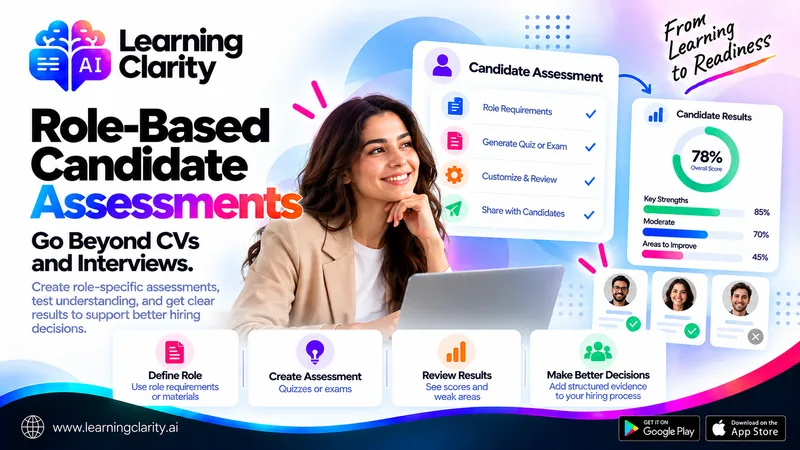
A CV summarizes experience. An interview reveals communication, judgment, motivation, and fit. Neither, by itself, proves that a candidate understands the knowledge required for a specific role. That is why many recruitment processes combine several selection methods rather than depending on a single signal.
Role-based candidate assessments add another source of evidence. They can help an HR team test defined knowledge or concepts before shortlisting, particularly when a role has clear technical, process, product, policy, or domain requirements.
With Learning Clarity, an HR team can create a Topic around role requirements and use Quiz or Exam Mode to assess understanding. The result should be treated as one input in the hiring process, not as an automatic hiring decision.
Why Candidate Assessment Should Be Role-Relevant
An assessment is useful only when it tests something that matters for the job. Generic knowledge tests may be easy to administer, but they can produce scores that are difficult to interpret. A better approach is to begin with the responsibilities of the role and identify the knowledge or skills that can reasonably be evaluated before hiring.
The CIPD selection methods factsheet distinguishes between interviews, psychometric tests, skill-based tasks, and assessment centres, and notes that skill-based assessments should resemble real job tasks where possible. For knowledge-focused roles, a structured exam can complement those methods by checking whether a candidate understands defined subject matter.
The Limits of CV-Only and Interview-Only Hiring
CVs are useful for screening background and experience, but they depend on self-reported information and do not show how well a candidate can recall or apply role-specific knowledge. Interviews add richer context, but unstructured interviews can vary widely between candidates and interviewers.
That does not make CVs or interviews obsolete. It means they work better as part of a broader evidence set. Recruitment quality improves when each method has a clear purpose: background screening, structured questioning, practical tasks, role-related knowledge checks, references, and human judgment.
How a Role-Based Assessment Workflow Works
A practical workflow begins by defining the role, identifying the knowledge areas that can be tested fairly, and deciding what type of questions fit the job. The assessment should then be reviewed by someone who understands the role before candidates receive it.
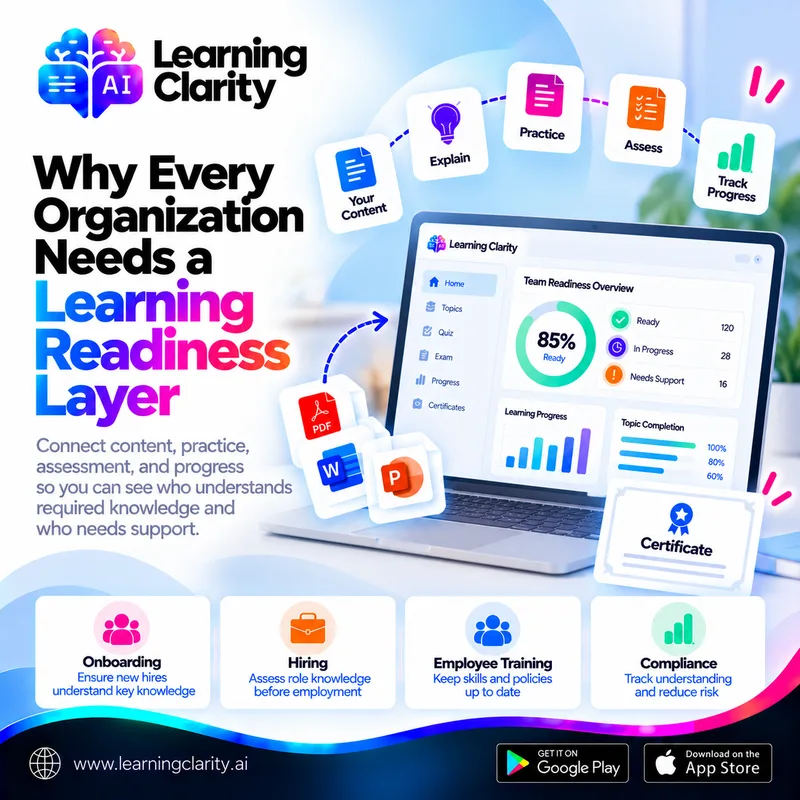
Inside Learning Clarity, HR teams can create a Topic from role requirements or relevant supplied material, select appropriate subtopics, and use Quiz or Exam Mode to create a structured assessment. Scores and weak areas can then be reviewed alongside the rest of the candidate evidence.
This approach is consistent with a broader skills-first direction in labour markets. The OECD Skills-First Labour Market report discusses the growing importance of skills in how organizations think about matching people to work, while also highlighting the need for credible ways to understand and signal capabilities.
What Should an Assessment Measure?
The answer depends on the job. A compliance role may require knowledge of regulatory concepts. A customer service role may require understanding of escalation rules or product policies. A technical role may require architecture or troubleshooting knowledge. A sales role may require product, process, and scenario knowledge.
Not every capability belongs in an online exam. Communication, collaboration, creativity, physical skills, and complex judgment may be better evaluated through interviews, work samples, simulations, or practical exercises. A role-based exam should focus on the knowledge it can measure reliably and leave the rest to other selection methods.
Practical Scenario: Screening Before the Final Interview
Imagine a company recruiting for a customer operations role. The team has a defined set of policies, product rules, and escalation procedures. After an initial application review, candidates receive a short role-related assessment covering those areas. The HR team reviews results and uses them together with interviews and practical exercises to decide who advances.
The exam does not tell the company who to hire. It gives the team another structured data point. A candidate who performs strongly may still need to demonstrate communication and judgment. A candidate who struggles on one topic may still be a viable hire if the gap is trainable and other evidence is strong.
How Learning Clarity Can Support the Transition Into Onboarding
One advantage of using a structured knowledge model in recruitment is that the same topic areas can inform onboarding after the person joins. The organization can take policies, product guides, SOPs, or other training material and turn them into learning Topics with explanations, quizzes, and exams.
The SHRM onboarding guide emphasizes that onboarding is more than initial paperwork. It includes helping new employees understand the organization, their role, and the information they need to perform. Learning Clarity can support that knowledge component while managers and HR continue to provide coaching, context, culture, and practical experience.
Best Practices for Fairer, More Useful Candidate Assessments
Keep assessments directly connected to the role, give candidates clear instructions, and avoid unnecessary complexity. Use consistent question sets or equivalent difficulty across candidates where fairness matters. Review generated questions before use, especially for high-stakes hiring decisions.
Use the assessment as evidence, not as an unquestioned verdict. Consider accessibility, language, time limits, and whether the test disadvantages candidates for reasons unrelated to job performance. Where possible, combine knowledge checks with structured interviews and realistic work samples.
Designing a Fair Candidate Assessment, Step by Step
Start from the role, not from a question bank. List the knowledge a new hire genuinely needs from the first day — the policies, product rules or technical concepts that cannot be picked up quickly on the job — and leave out everything that onboarding will teach anyway. Create the Topic from that scope so the questions cannot drift into trivia.
Ask someone who does the job to review every question before the assessment is used. Each question should have one clearly correct answer, use language the candidate pool will understand, and avoid internal jargon. Keep the question set and time limit the same for everyone applying to the same role so results can be compared fairly, and consider accessibility needs before the assessment is sent.
Decide in advance how the result will be used — for example, as one input to shortlisting alongside the CV review and interviews — and tell candidates what the assessment covers. After each hiring round, look at the questions that strong hires got wrong. A question that good candidates miss is more likely to be flawed than informative, and removing it makes the next round fairer.
Frequently Asked Questions
What is a role-based candidate assessment?
A role-based candidate assessment is a structured test focused on knowledge or skills relevant to a specific job. It can complement CV review, interviews, and work samples during selection.
Can an exam replace an interview?
No. An exam can provide evidence about defined knowledge, while interviews and practical tasks assess other dimensions such as communication, judgment, motivation, and applied performance.
Can Learning Clarity create candidate assessments?
Learning Clarity can support role-based Topics, quizzes, and exams that HR teams can use as one part of a broader assessment process.
Should candidate assessment results be the only hiring criterion?
No. High-stakes hiring decisions should use multiple relevant evidence sources and human judgment rather than relying on one score.
Conclusion
Better hiring is not about replacing human judgment with a score. It is about giving decision-makers clearer evidence before they make a decision.
If your recruitment process would benefit from a structured role-knowledge layer, create a free Learning Clarity account and test how a role-based Topic can be turned into a quiz or exam.
Try it with your own material
Create a free account and turn a document you already have into a structured Topic with explanations, quizzes and exams.
Create a free account