From Content to Measurable Learning, Hiring, and Training
Updated
Organizations and learners rarely suffer from a complete lack of information. The more common problem is that information sits in documents, slides, notes, and systems without a clear path from exposure to understanding. That makes it difficult to answer a basic question: what did the learner actually learn?
Measurable learning is not about turning every learning experience into a score. It is about building enough structure around learning to see progress, identify weak areas, and make informed decisions about what should happen next.
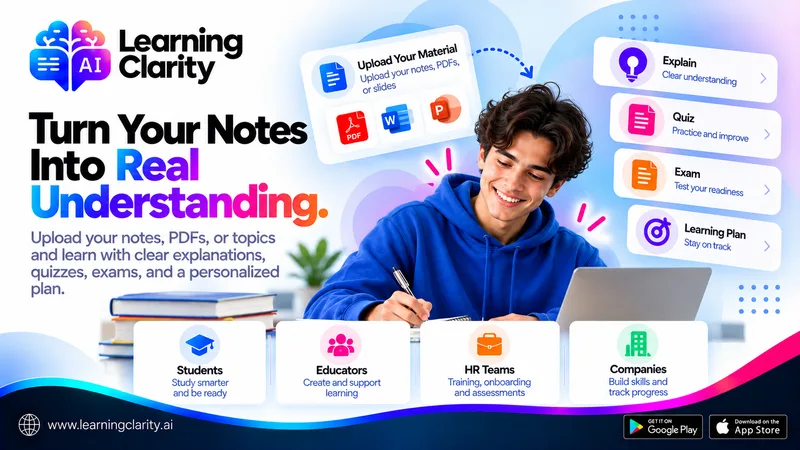
Learning Clarity brings Topic creation, explanations, quizzes, exams, progress tracking, supervision, and certificates into one workflow so that existing material can become more actionable for students, educators, HR teams, and companies.
What Does Measurable Learning Mean?
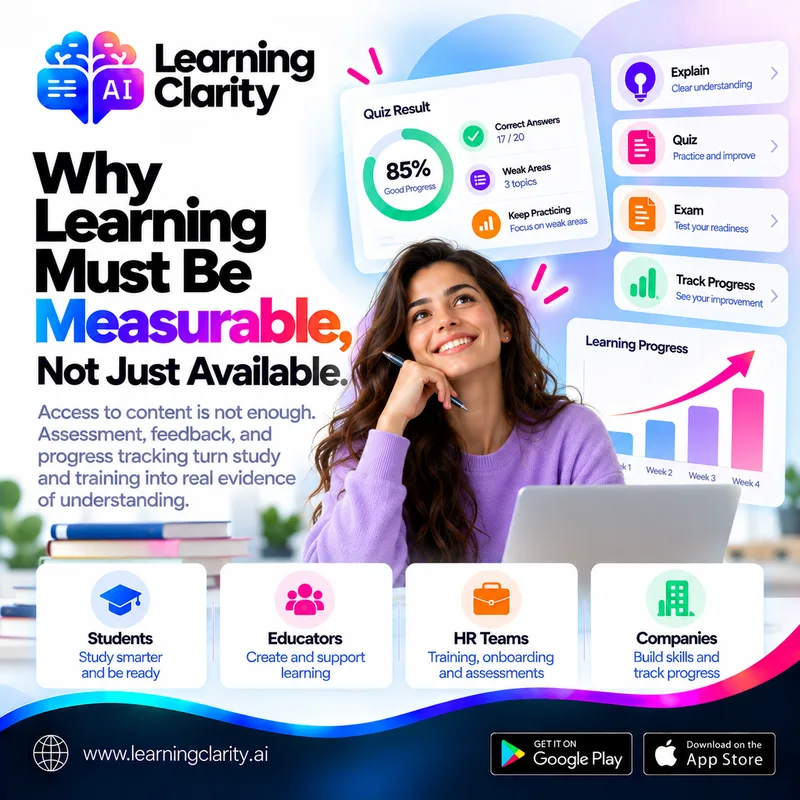
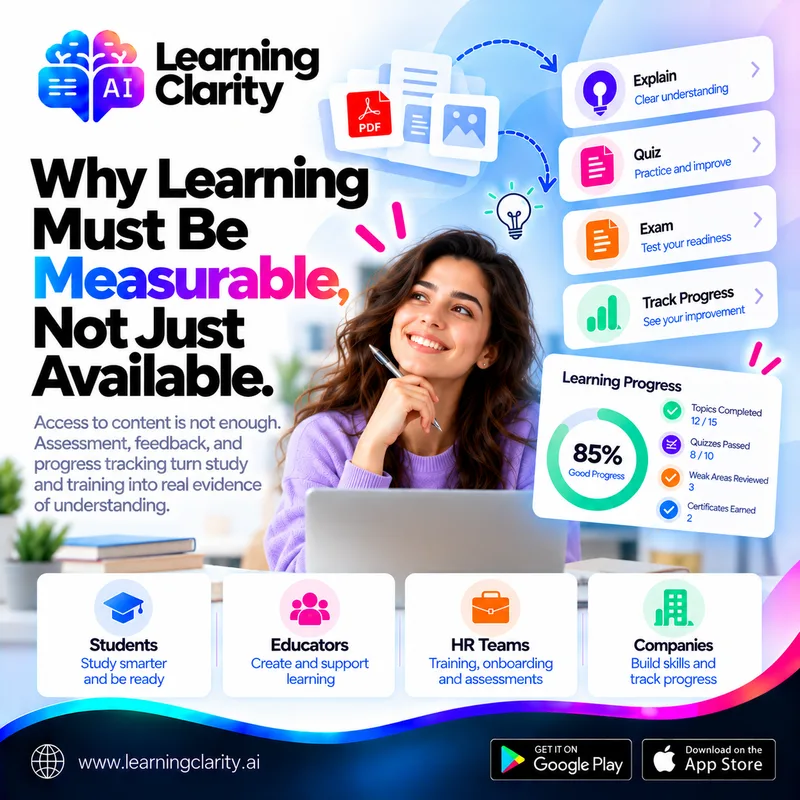
Measurable learning means connecting learning activity with observable evidence such as completion, quiz performance, exam results, repeated weak areas, and progression through structured content. It does not mean that every outcome is reducible to a number. Some capabilities still require observation, coaching, discussion, or practical performance.
The OECD report on how workers use skills makes a related point at the workplace level: developing skills is only part of the picture; how skills are used at work also matters. For learning teams, that means assessment data should support real decisions about practice, support, and readiness rather than exist only as dashboard decoration.
Why Traditional Content Delivery Leaves Blind Spots
A document can be opened without being understood. A video can be completed without being remembered. A training session can be attended without producing durable knowledge. Completion therefore tells us something, but not everything.
Active retrieval is one way to generate stronger evidence of understanding. The testing effect research reviews studies showing that retrieving information through tests can support later retention. In practice, quizzes and exams can serve both as checkpoints and as learning activities when they are paired with appropriate feedback.
How a Structured Learning Cycle Works
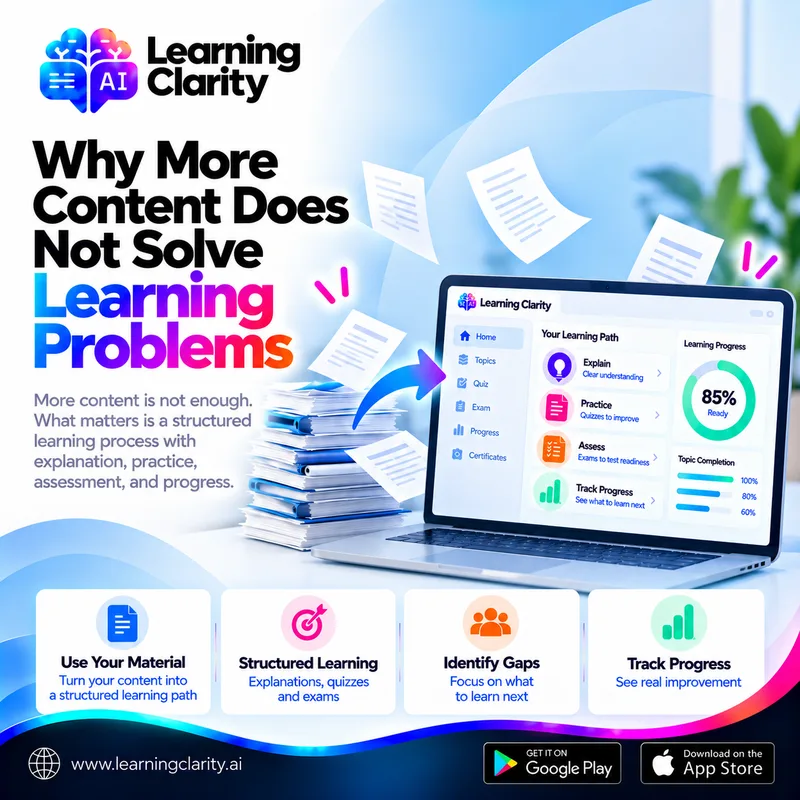
A useful learning cycle begins with clear content scope, continues through explanation and practice, and then uses assessment to identify what has and has not been learned. The next step is not simply to record a score; it is to use the result to decide whether the learner should move forward, revisit a subtopic, receive support, or repeat practice.
Learning Clarity supports this cycle through structured Topics and Subtopics. Explain Mode can help a learner work through the material, Quiz Mode provides lower-stakes practice, and Exam Mode provides a more formal readiness check. Progress tracking then makes the history visible over time.
How Measurable Learning Applies to Students
For students, the most valuable measurement is often diagnostic. A low score is not useful by itself; the useful part is seeing which concepts caused difficulty and what to study next. This is where weak-area visibility can turn assessment into a study plan.
The EEF guidance on feedback emphasizes that feedback should help learners understand performance relative to goals and identify actionable next steps. Learning tools should therefore connect results to improvement rather than only presenting a final percentage.
How It Applies to Hiring and Onboarding
In hiring, measurable learning becomes measurable role understanding. A candidate assessment can test defined knowledge before shortlisting, while interviews and practical exercises evaluate other capabilities. The goal is to add evidence, not automate the hiring decision.
In onboarding, the same principle applies after a person joins. Policies, SOPs, product guides, and internal processes can become structured Topics. New employees can study, practice, take exams, and build a visible learning record while managers provide coaching and practical context.
Practical Scenario: One Topic, Several Decisions
Consider a cybersecurity awareness Topic. An individual learner may use it to study and take an exam. A university instructor may assign it for revision. A company may use it as onboarding or compliance content. A manager may review completion and exam performance before confirming that additional support is not required.
The content is similar, but the decision changes. The individual asks, “Am I ready?” The teacher asks, “Who needs help?” The company asks, “Has the required knowledge been covered?” Measurement is useful because it helps each stakeholder answer the question that matters to them.
Best Practices for Measuring Learning Without Over-Simplifying It
Define the outcome before choosing the metric. Use quizzes for practice and diagnosis, exams for more formal readiness checks, and completion data for participation. Avoid treating a single score as proof of mastery when the topic requires practical performance or judgment.
Combine data with context. A manager should be able to see results but still talk to the learner. A teacher should use assessment evidence but still provide instruction. HR should use candidate results but still evaluate the whole person. Measurement should improve decisions, not replace them.
Choosing the Right Signal for Each Decision
Measurement becomes simpler when each metric is tied to the decision it informs. Before collecting any data, write the decision down in one sentence: “Should this learner move to the next Subtopic?”, “Does this candidate understand the policies the role depends on?”, “Is this new hire ready to work without support?” Each question points to a different signal.
For a study decision, a short quiz on the relevant Subtopic is usually enough. For a readiness decision, a broader exam across the whole Topic says more than any single quiz. For a hiring decision, the assessment result is one input to be read alongside interviews and practical tasks. Completion data answers a narrower question still: whether the assigned material was covered at all.
Matching signal to decision also shows what not to measure. If a number will never change what anyone does next, it adds noise to the report and effort for the learner. A small set of signals that each answer a real question is easier to act on than a large report nobody reads.
Frequently Asked Questions
What is measurable learning?
Measurable learning connects learning activity with evidence such as completion, quiz results, exam performance, weak areas, and progress over time so learners and supervisors can make better next-step decisions.
Is completion the same as understanding?
No. Completion shows that an activity was finished. Understanding usually requires additional evidence such as questions, assessments, explanation, discussion, or practical application.
Can Learning Clarity track learning progress?
Yes. Learning Clarity includes progress tracking and can record activity across Topics, quizzes, exams, and other supported learning workflows.
Can measurable learning be used in both education and corporate training?
Yes. The specific metrics differ, but both settings can benefit from connecting content with practice, assessment, feedback, and progress visibility.
Conclusion
Measurable learning is most useful when it helps answer what should happen next. The objective is not more data; it is clearer evidence that can guide study, support, hiring, onboarding, and training decisions.
To explore that workflow, start testing Learning Clarity with your own topic or material and see how explanation, practice, assessment, and progress tracking connect.
Try it with your own material
Create a free account and turn a document you already have into a structured Topic with explanations, quizzes and exams.
Create a free account