Why Learning Must Be Measurable, Not Just Available
Updated
Learning content has never been easier to distribute. A student can receive a PDF instantly. An employee can open an onboarding deck from anywhere. A candidate can receive role information before an interview. Yet distribution solves only the access problem.
The harder question is whether the learner understood what was shared. Without practice, assessment, and feedback, content availability can create an illusion of progress. People may finish the material while still carrying important knowledge gaps.
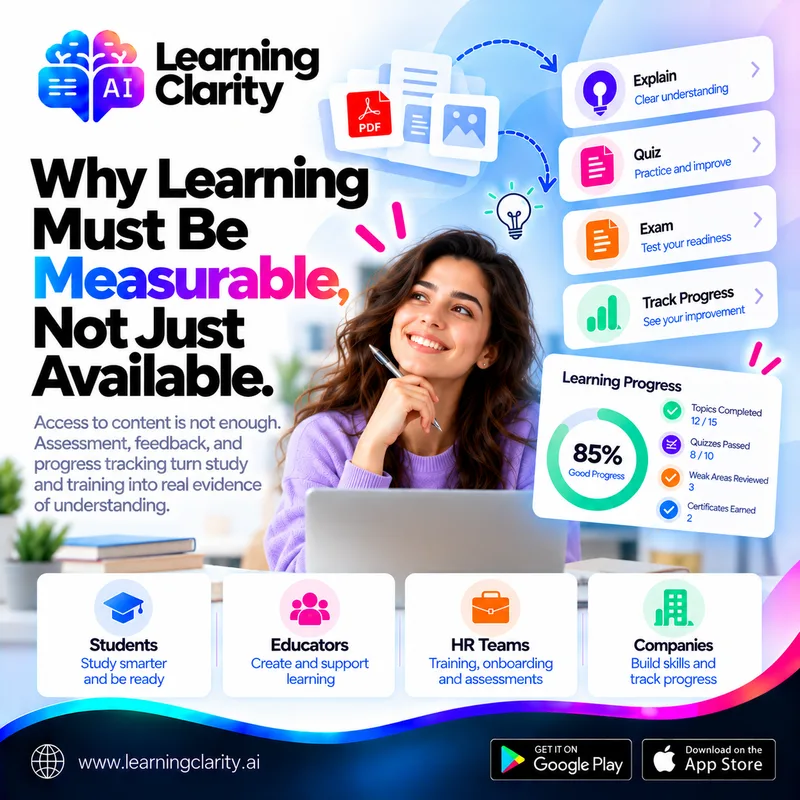
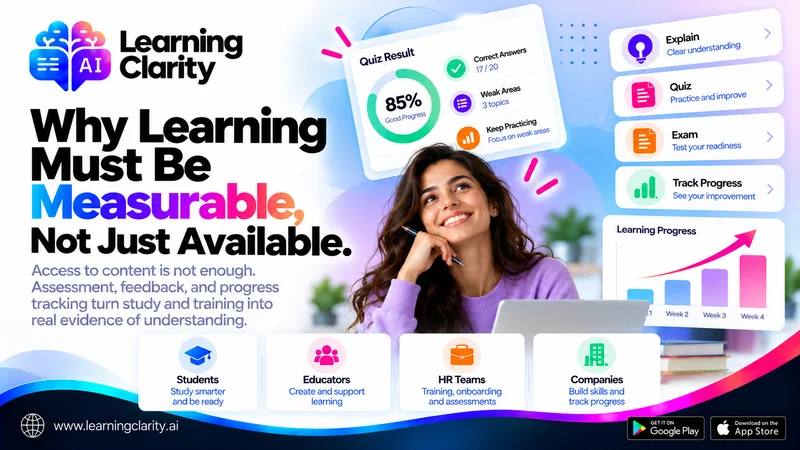
Measurable learning outcomes focus on what happens after access. Learning Clarity supports that shift by connecting Topics with explanations, quizzes, exams, progress tracking, weak-area visibility, and certificates.
Why Access and Learning Are Different
Access is a prerequisite for learning, but it is not evidence of learning. A learner can open a document and still misunderstand it. They can watch a video and forget the key ideas. They can complete a module without being able to retrieve the information later.
This distinction matters for both education and workplace learning. If the objective is only to distribute information, a file repository may be enough. If the objective is to build knowledge, the workflow needs opportunities to process, retrieve, apply, and revisit the material.
What Makes a Learning Outcome Measurable?
A measurable outcome is specific enough that progress can be observed. That might mean correctly answering questions about a concept, completing an exam, demonstrating knowledge across several subtopics, or showing improvement after revisiting weak areas.
The testing effect literature provides a useful foundation for why retrieval matters: testing can strengthen later retention compared with additional study alone. In a digital learning workflow, quizzes and exams can therefore serve as learning tools as well as measurement tools.
Feedback Turns Scores Into Next Steps
A score tells the learner what happened. Feedback should help explain what to do next. Without that second step, assessment can become a dead end: the learner sees 68%, but does not know which ideas require review or what practice would help.
The EEF evidence on feedback describes effective feedback as information tied to learning goals and improvement. Learning Clarity can support that process by showing results and weak areas so learners can return to the material with a clearer purpose.
Why Measurability Matters for Individuals
For an individual learner, measurement reduces guesswork. Instead of deciding readiness based on time spent studying, the learner can use quizzes and exams to check whether the knowledge is actually retrievable. Weak areas become a guide for the next study session.
This is useful for exam preparation, certification study, professional development, and self-directed learning. The point is not to test constantly. It is to place meaningful checkpoints where they can inform the learning plan.
Why It Matters for Organizations
For organizations, measurable learning makes training easier to manage. Managers can see whether assigned content has been completed, whether assessments were passed, and where additional support may be required. HR and L&D teams can compare learning activity with the objectives of onboarding, compliance, or internal development.
The OECD Trends in Adult Learning report highlights the importance of continued adult learning as skill needs evolve. Organizations therefore need more than content libraries; they need ways to understand participation, progress, and whether learning activities are aligned with changing skill demands.
Practical Scenario: From Policy Document to Readiness Check
Imagine a company introducing a new data-handling policy. Sending the PDF confirms distribution, but not understanding. A stronger workflow turns the policy into a structured Topic, explains the main concepts, gives employees practice questions, and uses a short exam to check the required knowledge.
Employees who struggle can revisit the relevant subtopics. Managers can see completion and results. The organization still needs operational controls and human oversight, but the learning component becomes much more visible than a simple “document sent” status.
Best Practices for Measuring Learning Well
Use measures that match the objective. A short quiz may be ideal for practice, while a timed exam may fit readiness or certification preparation. Avoid over-testing simple material, and do not use a knowledge score as a substitute for practical observation where the skill must be demonstrated in real work.
Keep measurement transparent. Learners should understand what is being assessed and why. Organizations should define how results will be used. Good measurement builds clarity; poorly designed measurement can create anxiety without improving learning.
Turning a Shared Document Into Something You Can Check
Most organizations and learners can start with material they already distribute. Take one document that people are expected to know — a policy, a product guide, a set of lecture notes — and ask what someone should be able to do after reading it. Three to five concrete outcomes are usually enough, such as “explain when an issue must be escalated” or “name the three stages of the approval process”.
Each outcome then becomes something a question can check. When the material is turned into a Topic, the Subtopics should line up with those outcomes, so a quiz result points back to a specific part of the content rather than to “the document” as a whole. Wrong answers show which outcome is not yet secure.
Keep the first version small. One document, a few outcomes and a short quiz already reveal more than a read receipt. Once the results show which outcomes are routinely missed, you know where to add explanation or practice — and whether the document itself needs rewriting.
Frequently Asked Questions
Why is access to content not enough?
Because opening or completing content does not prove that the learner understood, remembered, or can apply it. Practice and assessment provide additional evidence.
What are measurable learning outcomes?
They are observable indicators of learning, such as quiz performance, exam scores, completion, progress across subtopics, or identified areas that need improvement.
How can quizzes support learning?
Quizzes can provide retrieval practice, reveal misconceptions, and help learners decide what to review next.
How does Learning Clarity support measurable learning?
Learning Clarity connects structured Topics with Explain, Quiz, and Exam modes, progress tracking, weak-area visibility, and related learning features.
Conclusion
Learning becomes more useful when it moves beyond access and produces evidence that can guide the next step. Measurable learning outcomes do not replace teaching, coaching, or practical performance; they make understanding and progress easier to see.
If you want to test this approach with your own material, create a free Learning Clarity account and build a Topic that connects learning with practice and assessment.
Try it with your own material
Create a free account and turn a document you already have into a structured Topic with explanations, quizzes and exams.
Create a free account