From Learning Activity to Readiness: Why Progress Needs Evidence
Updated
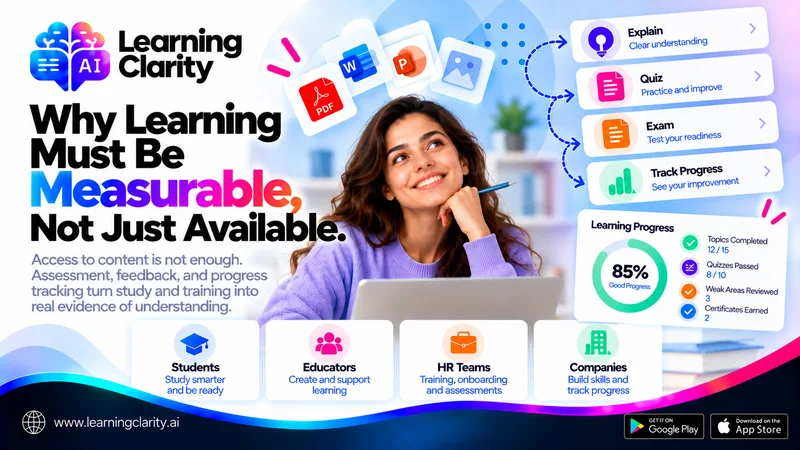
Learning platforms can record many activities: a learner opened a Topic, spent time in a module, finished a quiz, or completed an exam. Those events are useful, but activity should not be confused with readiness.
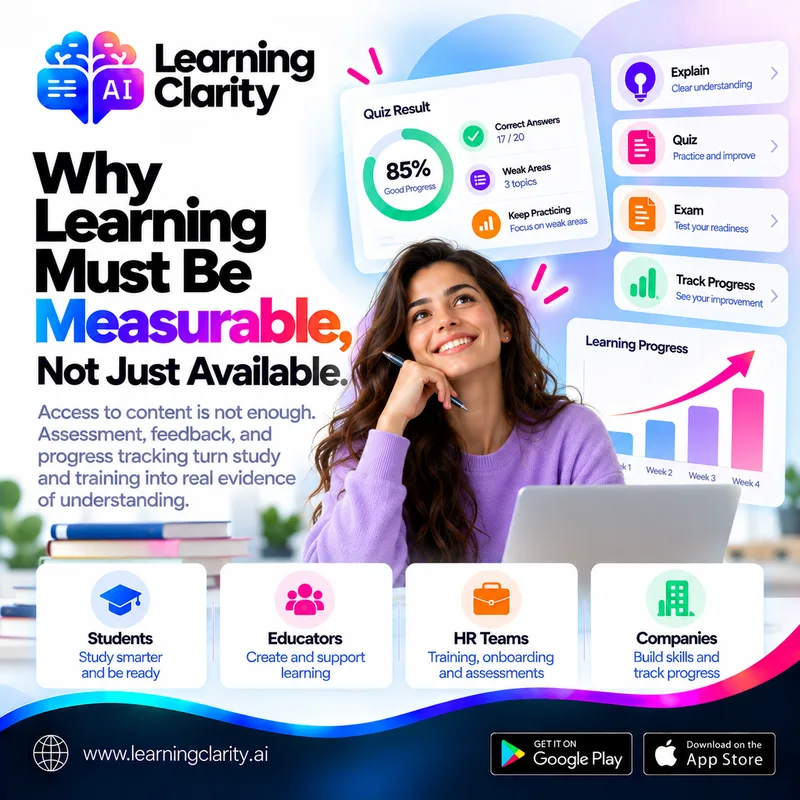
Learning readiness evidence comes from combining several signals: what material was completed, how the learner performed on practice and assessment, which areas were difficult, and whether performance is improving after review.
Learning Clarity supports this evidence-building process by connecting structured learning content with Explain Mode, Quiz Mode, Exam Mode, progress tracking, supervision, and certificates.
Why Activity Metrics Can Mislead
Time spent, clicks, and completion are easy to measure, which is why they often dominate learning dashboards. But they describe behavior, not necessarily understanding. A learner can spend a long time on content because it is difficult, because they are distracted, or because they are deeply engaged. The same metric can mean different things.
Readiness therefore needs a richer picture. Completion can confirm exposure. Quiz results can show recall and understanding. Exam performance can provide a more formal checkpoint. Weak-area patterns can indicate what should be revisited.
Assessment as Evidence, Not as Punishment
Assessment works best when it is connected to the learning goal and used to inform next steps. Low performance should not automatically be treated as failure; it can be a diagnostic signal that the learner needs another explanation or more practice.
The testing effect research shows why retrieval itself can contribute to learning. A well-designed quiz therefore has two roles: it produces evidence and gives the learner a chance to practice retrieving the knowledge they need.
Feedback Makes Evidence Actionable
Assessment data has limited value if the learner does not know what to do with it. The most useful result is one that points toward a next action: revisit a subtopic, practice a concept, ask for support, or move forward.
The EEF feedback evidence emphasizes the role of feedback in helping learners understand how their performance relates to goals. Learning systems should make that relationship visible instead of presenting scores without context.
How Learning Clarity Connects Activity to Readiness
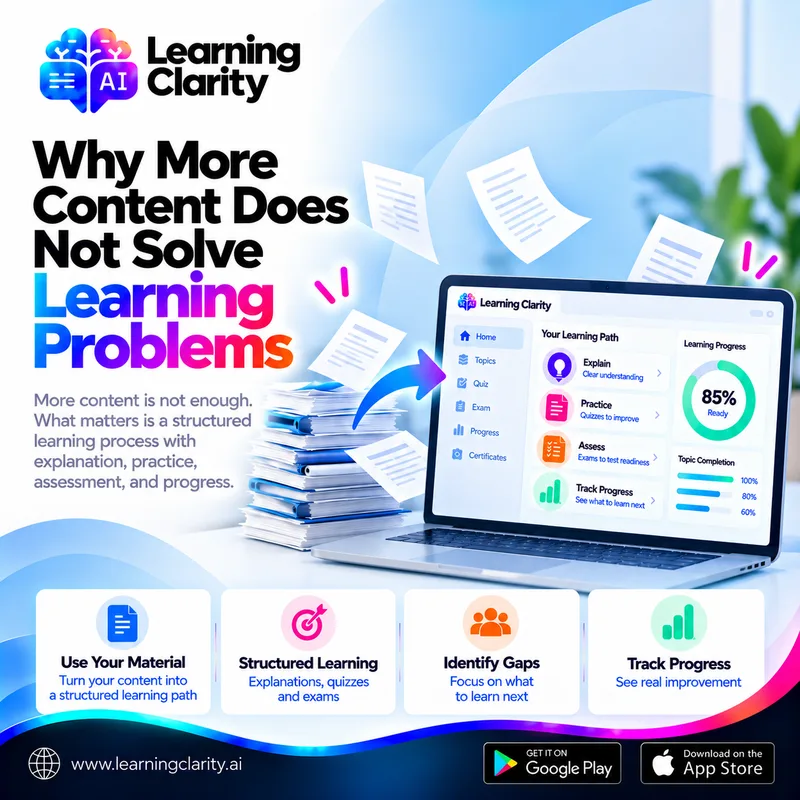
Learning Clarity organizes content into Topics and Subtopics, which makes the learning scope explicit. Explain Mode supports guided understanding, Quiz Mode offers practice, and Exam Mode can be used as a structured readiness check. Progress tracking then records the learning journey rather than a single result.
For supervisors, this can create a clearer view of who has completed required material, where performance is strong, and where more support may be useful. For learners, it provides a way to see progress and decide what to review next.
Practical Scenario: Preparing for a Professional Certification
An independent learner preparing for a certification can upload or describe the subject, work through the Topic, and take quizzes after each subtopic. When ready, they can use Exam Mode as a checkpoint. If results reveal consistent weakness in one area, that subtopic becomes the priority for the next study session.
The same logic can apply in a company. An employee completing role training can move through structured content, practice, and take a readiness assessment. The manager then has more evidence than a completion tick alone.
How Organizations Can Use Readiness Evidence Responsibly
Readiness data should be interpreted in context. A knowledge exam is appropriate for knowledge. It cannot prove every practical behavior, interpersonal skill, or real-world performance outcome. Managers should combine learning data with observation, coaching, work samples, and other relevant evidence.
The OECD report on workplace skills use reinforces that skills matter in how they are applied in work. Learning evidence can support readiness decisions, but organizations should still verify that knowledge transfers into the real task environment.
Best Practices for Better Readiness Decisions
Define what readiness means before designing the assessment. Use multiple small checkpoints rather than relying only on one final score. Make weak areas visible and give learners a path to improve. Keep assessment content aligned with the material that was actually taught or assigned.
For high-stakes decisions, add human review. Learning data is useful because it reduces guesswork, not because it eliminates judgment.
Building a Simple Readiness Record
Readiness is easier to judge when the evidence is collected the same way every time. A simple record for each learner and Topic can have four parts: which Subtopics were completed, how quiz results changed across attempts, the result of a broader exam, and which weak areas were revisited afterwards.
Read the record as a trend rather than a snapshot. A learner who scored poorly on the first quiz but improved after reviewing a Subtopic is showing exactly the pattern the process is designed to produce. A learner with a high first score and no further activity may be ready — or may simply have met material they already knew. The record helps a supervisor ask the right follow-up question instead of guessing.
Agree in advance what “ready” means for the Topic, for example a passed exam with no Subtopic left below an agreed level. Writing the rule down keeps decisions consistent between learners and makes clear which evidence still needs human judgment, such as practical tasks that no online assessment can observe.
Frequently Asked Questions
What is learning readiness evidence?
It is a combination of relevant signals, such as completion, quiz results, exam performance, progress, and weak-area patterns, used to judge whether a learner is ready for a next step.
Why is completion alone not enough?
Completion shows that an activity ended. It does not necessarily show that the learner understood or retained the material.
How can assessments support readiness?
Assessments can reveal what a learner can retrieve or understand and help identify topics that need more review.
Can Learning Clarity track readiness?
Learning Clarity can support readiness decisions through structured Topics, quizzes, exams, weak-area visibility, progress tracking, and supervision.
Conclusion
Readiness is stronger when it is supported by evidence rather than assumption. The goal is not to collect more learning data for its own sake; it is to make the next learning or management decision clearer.
You can start testing Learning Clarity with an existing topic and see how explanations, practice, assessment, and progress can work together.
Try it with your own material
Create a free account and turn a document you already have into a structured Topic with explanations, quizzes and exams.
Create a free account