Turn Any Learning Topic Into a Podcast With Learning Clarity
Updated
Training content is usually created for the screen. Policies become documents, product knowledge becomes slides, and onboarding becomes a sequence of pages employees are expected to read. Audio adds another format without requiring the organization to rebuild the underlying content.
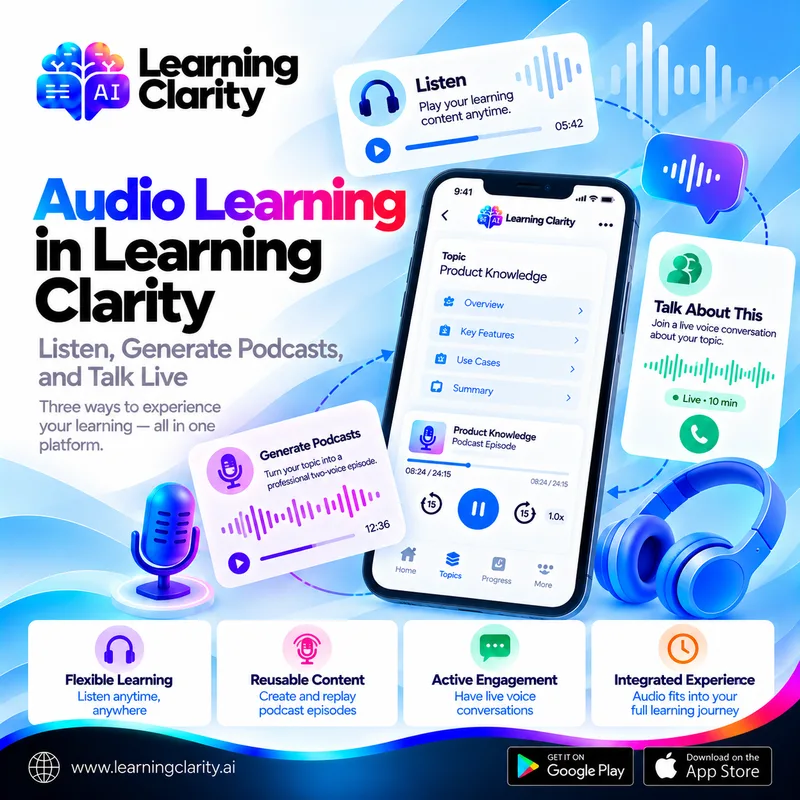
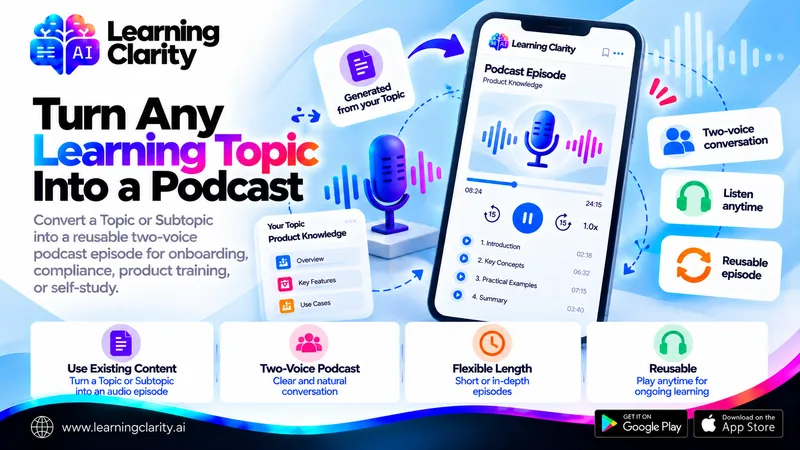
Learning Clarity can turn a Topic or Subtopic into a pre-produced, two-voice podcast-style episode based on the material already organized in the platform. The episode is generated once, saved, and can be replayed later.
This gives L&D teams and individual learners another way to use the same structured content inside Learning Clarity without setting up a separate recording workflow.
What Is a Learning Podcast Generator?
A learning podcast generator converts structured educational or training material into an audio episode that can be listened to rather than read. In Learning Clarity, the source is an existing Topic or Subtopic, so the audio remains connected to the same learning structure used elsewhere in the platform.
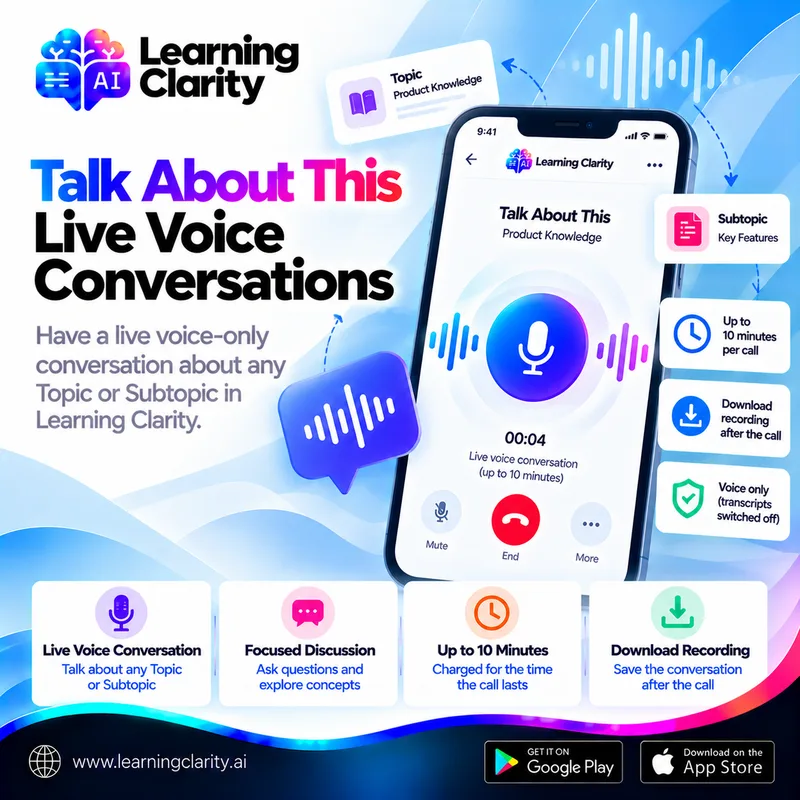
The feature is designed as a generated episode, not a live call. Once the episode has been created, it is reusable content and can be played again without generating a new version each time.
Why Audio Can Complement Structured Learning
Audio is useful because it changes the conditions under which learners can revisit material. It does not require the same visual attention as a document or slide deck, which can make it a practical supplementary format for review.
Research on educational podcasts is context-dependent, so broad claims should be avoided. A recent systematic review of educational podcasts found positive learner perceptions across included dental education studies but also noted that the evidence base was small, heterogeneous, and often at risk of bias. The safest conclusion is that podcasts can be a useful adjunct when they are designed and evaluated carefully.
How Podcast Generation Works in Learning Clarity
An organization or learner starts with a Topic or Subtopic that already contains the learning structure. The podcast feature uses that material to create a two-voice episode. The user does not need to upload a separate script or record the speakers manually.
Topic-level episodes can cover several subtopics and may run from a few minutes up to approximately 25–30 minutes depending on the material. A focused subtopic has a shorter practical cap. The generation interface can show an estimated credit cost before creation, while the completed episode is charged based on the content actually generated.
Why Length Should Follow the Learning Scope
Audio becomes less useful when length is chosen independently of the content. A narrow concept may only support a short refresher, while a complete onboarding Topic can support a longer overview. Stretching a small idea into a long episode risks repetition; compressing a large topic too aggressively can remove important context.
The best approach is to choose the scope first, then choose the episode length that fits it. Subtopics work well for focused listening, while full Topics support broader coverage.
Practical Scenario: Compliance Refresher
An L&D team already has a compliance Topic covering reporting obligations, escalation, conflicts, and record keeping. Instead of producing a separate audio program, the team generates a podcast episode from the existing Topic and publishes it alongside the structured learning content.
Employees can listen to the episode as a refresher, while quizzes or exams remain available when the organization needs assessment evidence. The audio format complements the learning workflow rather than replacing it.
Persistent Playback Makes the Format More Usable
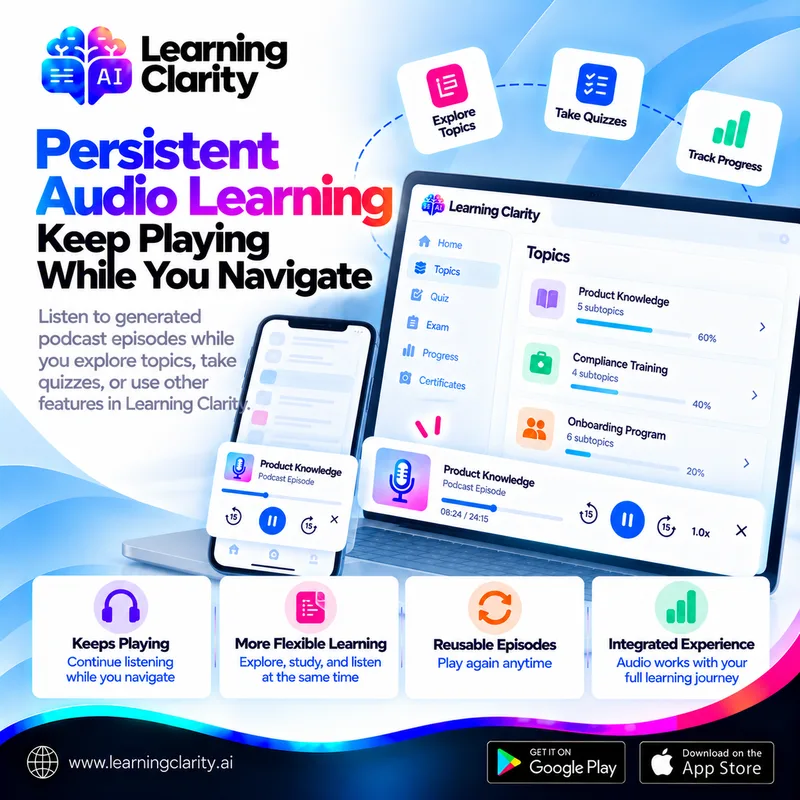
Once generated, a Learning Clarity podcast can play through a persistent player inside the application. The learner can navigate elsewhere in the platform while the episode continues, which makes the audio experience behave more like a normal listening tool than a single static lesson page.
Research on podcast design also suggests that delivery details matter. A study on prosodic signals in podcast learning examined how vocal cues such as pace and volume can affect learning. The broader lesson for L&D teams is that audio quality and instructional design matter; simply converting text into sound is not enough.
Best Practices for Training Podcasts
Use podcasts as part of a blended learning design. Keep the source Topic accurate and current, choose a length that fits the scope, and use quizzes or exams when you need evidence of understanding. Do not assume that listening automatically produces retention.
For controlled organizational content, define who is responsible for generating and publishing episodes. Treat the audio as another representation of the training material, not as a separate unofficial source.
Choosing Which Topics to Turn Into Episodes
Not every Topic makes a good episode. Material that can be followed by ear works best: concepts, reasoning, policies, case descriptions and product positioning. Material that depends on tables, diagrams, formulas or step-by-step screen instructions is harder to follow without looking, and is usually better kept as text with a quiz alongside it.
Start with a Topic learners already come back to, such as an onboarding overview or a compliance refresher, and generate one episode sized to its scope — a short one for a single Subtopic, a longer one for a full Topic. Listen to it yourself before recommending it, and check that it reflects the current version of the source content.
When the source Topic changes, decide whether the episode still holds. Because episodes are generated once and saved, an old episode can outlive the material it was based on. Keeping a simple note of which episode belongs to which version of the Topic stops learners from listening to guidance that has since been updated.
Frequently Asked Questions
Can Learning Clarity turn a Topic into a podcast?
Yes. A Topic or Subtopic can be used to generate a pre-produced, two-voice audio episode based on the learning material.
Is the podcast generated once or every time I listen?
It is generated once and then saved as reusable audio that can be replayed.
How long can a Learning Clarity podcast be?
Topic-level episodes can range from a few minutes up to roughly 25–30 minutes depending on content, while focused subtopics support shorter episodes.
Does podcast learning replace quizzes or exams?
No. Audio is an additional content format. Quiz and Exam modes remain useful when learners or organizations need practice and assessment evidence.
Conclusion
Podcast generation gives learners and L&D teams another way to use content they already have. The strongest use case is not replacing structured learning, but extending it into a reusable audio format connected to the same Topic.
Explore the platform through Learning Clarity or create a free account and test how one existing Topic can become a listenable episode.
Try it with your own material
Create a free account and turn a document you already have into a structured Topic with explanations, quizzes and exams.
Create a free account