Exam Mode in Learning Clarity: Test Understanding Before the Real Exam
Updated
Learners often ask the wrong question before an exam: “Have I studied enough?” A more useful question is “What can I actually retrieve and apply without looking at my notes?”
Practice exams create a controlled way to answer that question. They can expose weak areas, help learners experience time pressure, and provide evidence about readiness before the real assessment matters.
Learning Clarity includes Exam Mode as one of its core learning modes, alongside Explain Mode and Quiz Mode. Learners can use it to test knowledge across selected subtopics and review performance as part of a broader study cycle.
What Is Exam Mode?
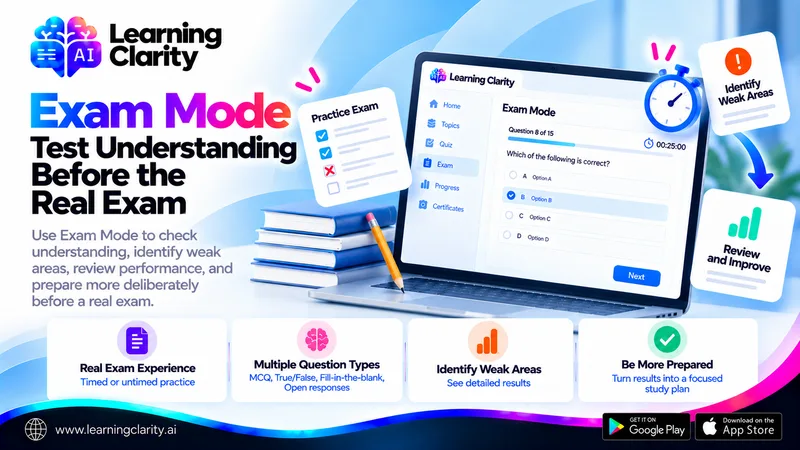
Exam Mode is a structured assessment experience designed to test understanding across selected learning content. Depending on the configuration, an exam can use question types such as multiple choice, true/false, fill-in-the-blank, and open-ended written answers, and it can be timed or untimed.
The purpose is different from a quick practice quiz. A quiz is often used for lower-stakes retrieval and immediate learning. Exam Mode is better suited to a broader readiness checkpoint after the learner has worked through the material.
Why Practice Exams Can Improve Preparation
The testing effect research explains why retrieving information can strengthen memory and why testing can support learning rather than merely measure it. Practice exams combine retrieval with a realistic checkpoint that helps learners see what they can produce under more constrained conditions.
The benefit comes from what happens afterward. A practice exam should lead to review. Learners should identify the subtopics that caused difficulty, return to the material, practice again, and then use another assessment later.
How Exam Mode Fits With Explain and Quiz Modes
Learning Clarity works best when the three modes are treated as a sequence rather than isolated features. Explain Mode supports understanding, Quiz Mode supports frequent practice, and Exam Mode provides a broader test of readiness.
A learner who performs poorly in Exam Mode does not need to restart everything. They can use the result to return to the relevant subtopics, simplify difficult ideas, request further explanation, and practice before another exam attempt.
What Exam Results Should Tell the Learner
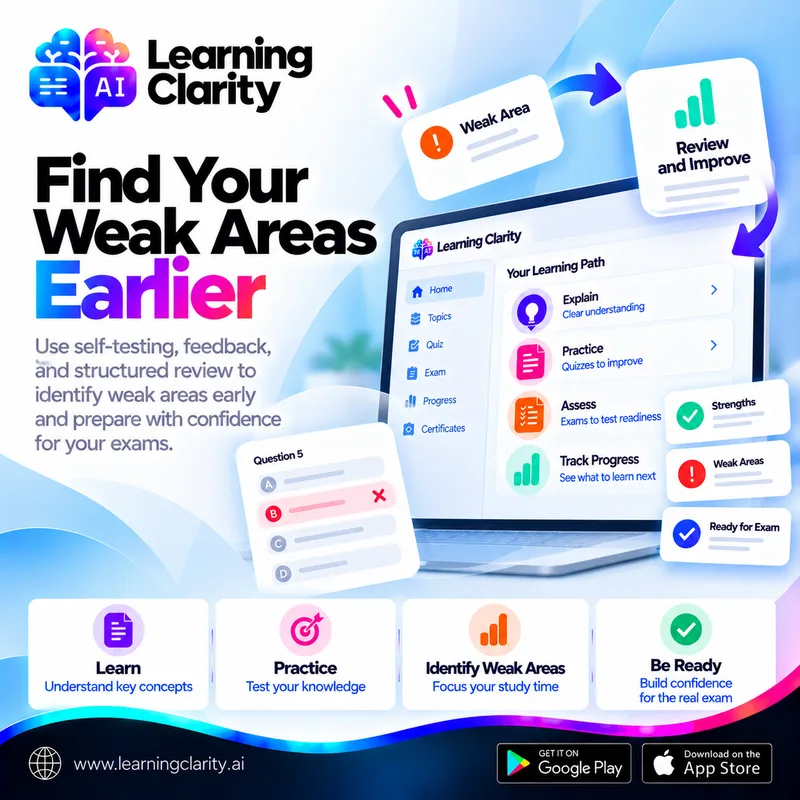
A useful exam result should answer more than “pass or fail.” It should help the learner see overall performance, where errors were concentrated, and what should be reviewed next. The goal is to convert the exam from an endpoint into a diagnostic checkpoint.
This aligns with the broader principle in the EEF feedback evidence that feedback should help learners understand performance relative to goals and support improvement.
Practical Scenario: Preparing for a Certification
A professional is preparing for a certification that covers five knowledge domains. They create a Topic from their study material, use Explain Mode for unfamiliar concepts, and take quizzes after each domain. One week before the real test, they use Exam Mode across all five areas.
The result shows that three domains are strong but two contain repeated errors. The learner spends the next sessions on those weak areas, then takes another practice exam. The exam has become a planning tool, not only a score.
Using Timed and Untimed Exams Deliberately
Untimed practice can be useful when the objective is understanding and careful reasoning. Timed practice adds another variable: can the learner retrieve and answer within a realistic constraint? The right choice depends on the real assessment and the stage of preparation.
Learners should avoid using time pressure too early if it prevents them from learning from the questions. Build understanding first, then add realism as the exam approaches.
Common Exam Preparation Mistakes
One mistake is waiting until the end of revision to take the first full practice exam. Another is repeating exams without reviewing mistakes. A third is memorizing answer patterns rather than understanding the concept behind them.
Use Exam Mode as evidence. When a result changes what you study next, the assessment is doing useful work.
Setting Up a Practice Exam That Mirrors the Real One
A practice exam is most informative when it resembles the assessment you are preparing for. Before starting Exam Mode, check the real exam’s format: which topics it covers, whether it is timed, and what kinds of questions it uses. Then select the matching Subtopics and choose question types and timing that are close to those conditions.
If the real exam asks for written answers, include open-ended questions rather than relying only on multiple choice, which tests recognition more than recall. If it is timed, take at least one practice exam with a time limit so that pacing problems appear before the day that matters.
After each attempt, note the result and the Subtopics where errors were concentrated, then decide the next step before closing the results: which areas to revisit and when to take the next exam. Leaving a few days between attempts gives the review time to work and makes the next result a fairer test of what you have actually retained.
Frequently Asked Questions
What is Exam Mode in Learning Clarity?
Exam Mode is a structured assessment mode that tests understanding across selected learning content and can support timed or untimed exam practice.
What question types can Exam Mode use?
Learning Clarity exams can include multiple-choice, true/false, fill-in-the-blank, and open-ended questions.
Is Exam Mode the same as Quiz Mode?
No. Quiz Mode is better suited to ongoing practice, while Exam Mode provides a broader readiness checkpoint across selected content.
Can Exam Mode show weak areas?
Exam results and performance review can help learners identify areas that need further study before the next attempt or the real exam.
Conclusion
Exam readiness is easier to judge when learners test themselves before the real assessment. The combination of explanation, practice, exam conditions, and review creates a more deliberate preparation process.
Use Learning Clarity Exam Mode with your own Topic, or start a free Learning Clarity account and build a study workflow around your next exam.
Try it with your own material
Create a free account and turn a document you already have into a structured Topic with explanations, quizzes and exams.
Create a free account