How Individual Learners Can Find Weak Areas Before the Real Exam
Updated
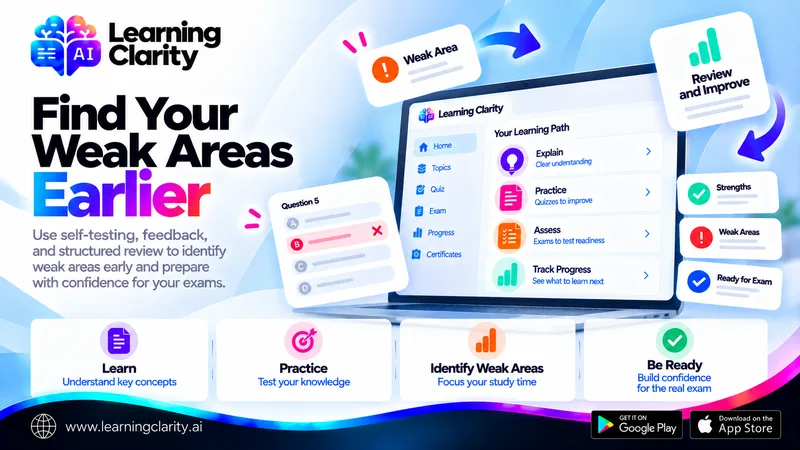
Many learners discover their weak areas too late. They read notes, watch explanations, and feel familiar with the material, only to find during the real exam that familiarity was not the same as being able to retrieve the answer.
The solution is not necessarily more study time. It is earlier evidence. Self-testing gives learners a way to check what they can actually recall and understand before the final assessment matters.
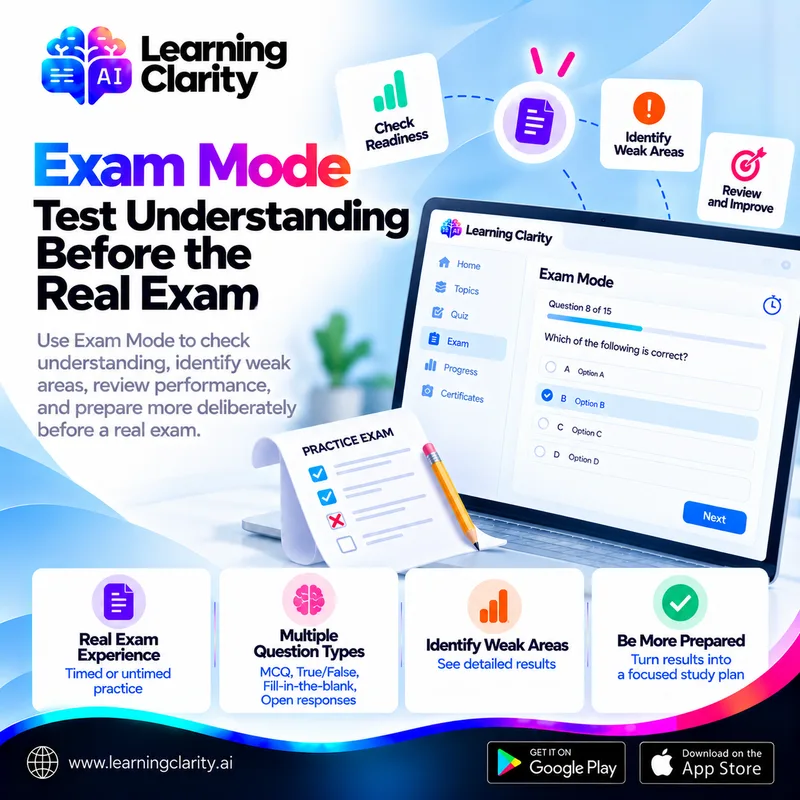
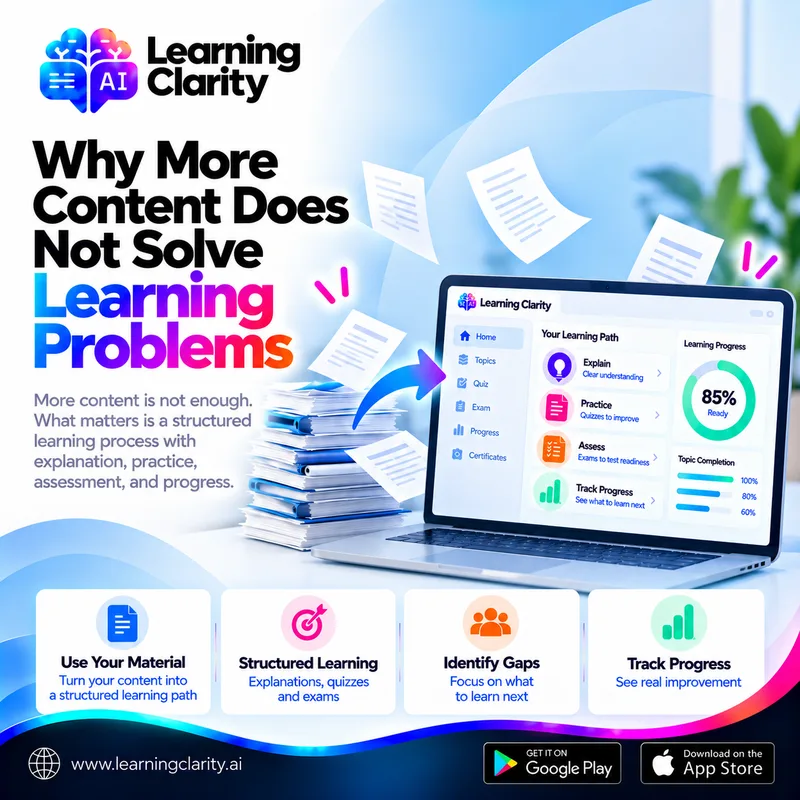
Learning Clarity can support that process through structured Topics, Explain Mode, Quiz Mode, Exam Mode, and progress tracking, helping independent learners turn weak areas into a study priority instead of a surprise.
Why Familiarity Can Feel Like Mastery
Reading the same material repeatedly makes it feel familiar. That feeling can be useful, but it is not the same as retrieving the information without help. Learners often overestimate readiness because the answer looks obvious when it is visible in the notes.
Self-testing changes the task. Instead of recognizing information, the learner must produce or select an answer from memory. The gap between what feels familiar and what can be retrieved becomes visible.
Why Retrieval Practice Helps
The testing effect research describes a well-established finding: tests can strengthen later retention and can be more effective than additional restudy in some conditions. This makes quizzes useful before the final exam, not only after the learner has finished studying.
The key is to use the result as guidance. A wrong answer should trigger review and another attempt, not simply frustration. The learner should know which concept to revisit and why.
How to Build a Weak-Area Study Loop
A practical loop is simple: study a focused subtopic, take a short quiz, review the result, revisit the concepts that were missed, and test again later. After several subtopics, use a broader exam to check whether the knowledge holds together across the full topic.
This approach is more targeted than repeating all of the material. It directs time toward the places where the learner has evidence of difficulty.
How Learning Clarity Supports the Process
Learning Clarity can create a structured Topic from a description or supplied learning material. Explain Mode supports the first pass through the content, while Quiz Mode provides lower-stakes practice. Exam Mode can then act as a broader readiness checkpoint.
Progress tracking helps the learner see activity and results over time. The platform should be used as a study system: learn, test, review, and repeat where needed.
Feedback Matters More Than the Score
A score can tell you that something went wrong, but useful feedback tells you where to focus. The learner needs to see whether the issue was a particular concept, a misunderstanding of the question, or a broader gap in the topic.
The EEF feedback guidance emphasizes specific, actionable information tied to learning goals. This principle applies to self-study as well: the value of a practice test is what it helps you do next.
Practical Scenario: Preparing for a University Exam
A student has two weeks before a final exam and five major topic areas. Instead of rereading the entire course each day, the student creates Topics from the core material, works through explanations, and takes quizzes after each area. The results show strong performance in three areas and repeated errors in two.
The next study sessions focus on those two areas. A full Exam Mode session later in the week checks whether the improvement holds across the complete subject. The student is using evidence to allocate study time rather than studying every topic equally.
Best Practices for Individual Learners
Test yourself before you feel completely ready. Keep quizzes short enough that you will actually use them. Review explanations after mistakes. Separate practice from the final high-pressure test so you can learn from errors safely.
Do not chase a perfect score on every attempt. The point of practice is to reveal what needs work. Improvement over time is more useful than protecting yourself from mistakes.
Planning the Final Week Before an Exam
In the last week, the goal shifts from covering material to closing specific gaps. Start the week with a broad practice exam across the whole Topic — not to get a good score, but to get an up-to-date map of your weak areas. Rank those areas by how much they are likely to matter in the real exam and how far your results are from where they need to be.
Spend the middle of the week on the top of that list. For each weak Subtopic, revisit the explanation, take a short quiz, and go through every wrong answer until you can say why the correct answer is correct. Mix in a few questions from your strong areas so they do not fade while you focus elsewhere.
End the week with a second practice exam under conditions close to the real one, including the time limit if there is one. Compare the result with the first exam of the week. If the same areas are still weak, you know where to spend the remaining time; if they have improved, you go into the real exam with evidence rather than hope.
Frequently Asked Questions
How can I find my weak areas before an exam?
Use short self-tests throughout your study process, review which concepts you miss, and focus later study sessions on those areas before taking a broader practice exam.
Is rereading enough for exam preparation?
Rereading can support understanding, but self-testing adds evidence about what you can retrieve without looking at the source.
How can Learning Clarity help with exam preparation?
Learning Clarity can structure material into Topics, provide explanations, support quiz practice, offer Exam Mode, and track progress and weak areas.
When should I start practice testing?
Start before the final days of revision. Early practice gives you time to identify gaps, review the material, and test again.
Conclusion
Weak areas are most useful when you discover them early enough to act. Self-testing turns uncertainty into a plan: learn, retrieve, review, and repeat.
If you want a structured way to do that with your own material, create a free Learning Clarity account and build a Topic for your next exam or learning goal.
Try it with your own material
Create a free account and turn a document you already have into a structured Topic with explanations, quizzes and exams.
Create a free account