One Learning Platform for Students, Educators, HR Teams, and Companies
Updated
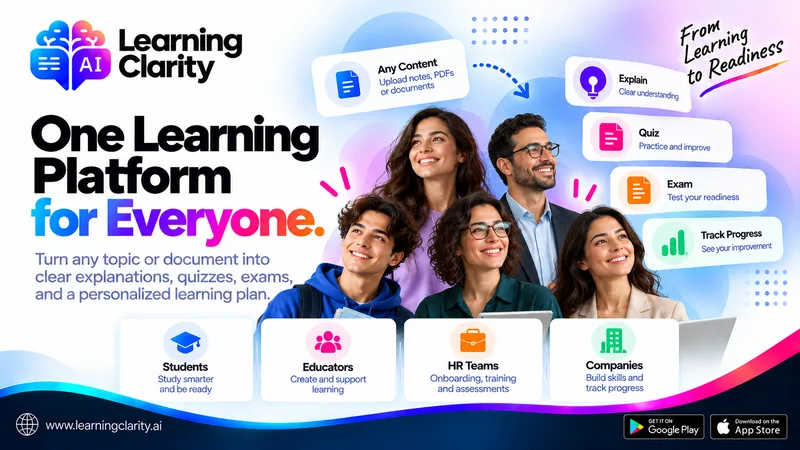
Learning technology is often evaluated by audience: one tool for students, another for teachers, another for corporate training, and another for recruitment. In practice, many of these use cases share the same underlying problem. People already have content, but they need a reliable way to turn that content into understanding, practice, assessment, progress visibility, and evidence of completion.
That common workflow is why a learning platform for students and organizations can create value across very different settings. The content may be a lecture note, a university handout, an onboarding policy, a product guide, a job requirement, or a professional development document. What changes is the context; what stays consistent is the need to structure the learning journey.
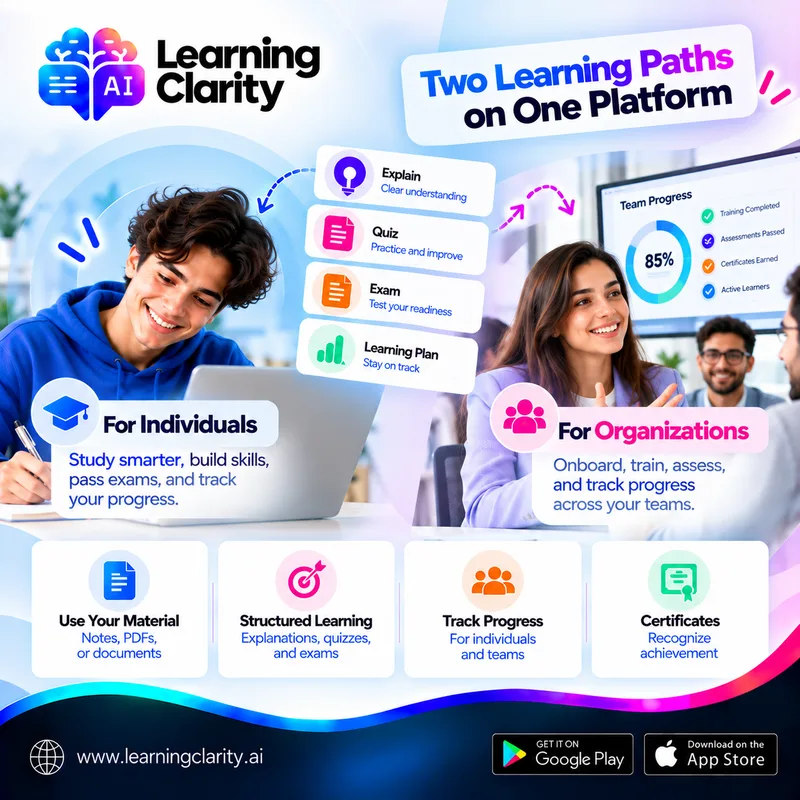
Learning Clarity is designed around that shared workflow. Users can create Topics from descriptions or supplied materials, learn through Explain Mode, practice in Quiz Mode, test readiness in Exam Mode, and follow progress over time. The same foundation can support individual learners, educators, supervisors, HR teams, and organizations without pretending that every audience has identical needs.
Why One Learning Workflow Can Serve Different Audiences
The value of a common learning workflow is consistency. Students need to know what they understand and where they are weak. Teachers need visibility into progress. HR teams need evidence that a candidate understands role-related knowledge. Managers need to know whether employees have completed and understood required learning. Independent learners need structure when they are teaching themselves.
These needs align with broader evidence about adult learning and skills development. The OECD Trends in Adult Learning report examines how adults participate in learning and why flexible, relevant learning opportunities matter as skill needs change. The technology layer should not replace instruction or professional judgment; it should make learning easier to organize, practice, assess, and review.
The Problem With Content-Only Learning
Content availability is no longer the main bottleneck. Learners can access documents, videos, presentations, online courses, and internal knowledge bases. The harder problem is converting access into understanding. Simply assigning material does not reveal whether a learner can recall it, apply it, or identify what still needs work.
This is one reason active practice and feedback matter. Research summarized in the Education Endowment Foundation feedback evidence describes feedback as information about performance relative to a goal and emphasizes the importance of specific, actionable guidance. A structured platform can make room for that cycle by combining learning content with questions, exams, results, and progress data.
How Learning Clarity Supports Students and Independent Learners
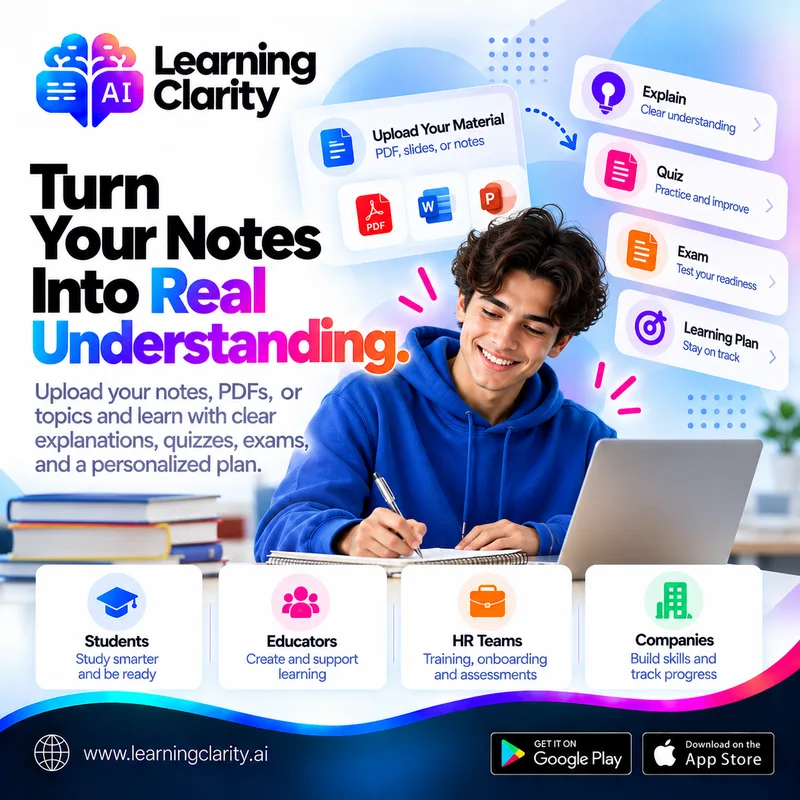
Students can create a Topic from uploaded material or a description, then move through the content in a more deliberate sequence. Explain Mode can break down a subject into manageable parts, while Quiz Mode creates opportunities to practice retrieval and check understanding. Exam Mode adds a more formal readiness check when the learner wants to simulate a test experience.
Testing is not only useful as an evaluation step. The testing effect research reviews evidence that retrieving information through tests can strengthen later retention compared with restudying alone. Learning Clarity uses quizzes and exams as part of a wider study workflow rather than treating assessment as something that happens only at the end.
How Educators and Institutions Can Use the Same Structure
Teachers and educational institutions can use the same Topic structure to support revision, after-class study, and progress visibility. The platform is not a replacement for teaching. It can act as a support layer around existing instruction by giving learners structured explanations, practice opportunities, and assessment results that can inform further support.
This is especially useful when an institution already has curriculum material but wants to make it easier for learners to revisit, practice, and demonstrate understanding outside the classroom. Supervision and progress tracking can help authorized educators follow activity without turning every learning interaction into manual reporting.
How HR Teams and Companies Can Apply the Model
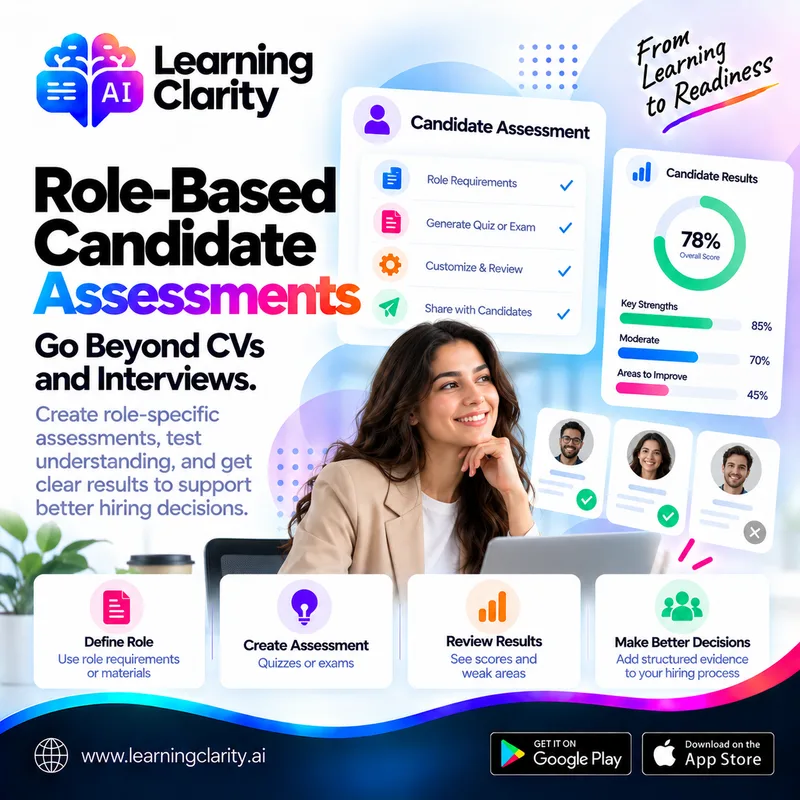
In a company, the same workflow can begin with a different source: a job description, policy, SOP, employee handbook, product guide, or onboarding deck. HR teams can use role-based assessments as one input during hiring, while onboarding teams can turn internal material into structured learning Topics for new employees.
The CIPD selection methods guidance discusses interviews, skill-based assessments, work samples, and other selection methods. The practical implication is that candidate assessment should be role-relevant and used as part of a broader selection process. Learning Clarity can support that assessment layer without replacing interviews, reference checks, or human decision-making.
After hiring, the SHRM new employee onboarding guide provides useful context on onboarding as a broader process of integrating new employees with the organization and equipping them with the information they need. Learning Clarity can help structure the knowledge-learning part of that process through Topics, quizzes, exams, progress tracking, and certificates.
Practical Scenario: One Platform, Different Paths
Consider three users working in the same week. A university student uploads lecture notes and uses Explain Mode to understand a difficult concept before taking a practice exam. A teacher assigns structured revision content and reviews progress. An HR team creates a role-related knowledge assessment, then later turns onboarding policies into learning Topics for the person who is hired.
The platform is the same, but the objective changes. The student is preparing for an exam. The teacher is supporting progress. The HR team is gathering assessment evidence and then supporting onboarding. A shared workflow reduces fragmentation while still allowing each audience to use the features that fit its own goal.
What Should Be Measured?
Measurement should follow the purpose of the learning activity. For an individual, useful signals can include topic completion, quiz performance, exam scores, repeated weak areas, and improvement over time. For an organization, it may also include completion by assigned learners, readiness checks, certification status, and areas where additional support is needed.
The goal is not to reduce learning to a single score. Good learning data should help the learner or supervisor decide what to do next: revisit a concept, practice again, provide coaching, move to the next module, or confirm that required material has been completed.
Best Practices for Using a Shared Learning Platform
Start with a clear learning objective, keep Topics scoped around meaningful outcomes, and use assessments that reflect what the learner actually needs to know. Avoid adding quizzes simply because the tool can generate them. Each assessment should answer a useful question about understanding or readiness.
For organizations, keep ownership clear: decide who authors content, who assigns it, who reviews results, and what evidence is required before someone moves forward. For individuals, use the platform as a study system rather than a one-time answer generator. Revisit weak areas, repeat practice, and use exams as checkpoints.
A First Week on a Shared Learning Platform
Pick one real piece of material rather than planning an entire curriculum. A student might choose the lecture notes for the next exam; a teacher, the revision unit for one class; an HR team, the job description for an open role or the onboarding policy new starters read first. Create one Topic from it and check that the Subtopics match how the material is actually organized.
Then give each audience a checkpoint that fits its goal. Students work through Explain Mode and finish each Subtopic with a short quiz. Teachers look at which Subtopics produce the most wrong answers before the next lesson. HR teams review the questions with someone who knows the role before any candidate sees them, and onboarding teams agree what exam result means a new employee is ready to move on.
At the end of the week, compare what the results showed with what you expected. If the weak areas are the ones you predicted, the Topic is doing its job. If they are surprising, that is useful too: it points to a concept that needs a clearer explanation, an example, or more practice. One well-scoped Topic teaches you more about how the platform fits your context than a large rollout planned in advance.
Frequently Asked Questions
Can Learning Clarity be used by both individuals and organizations?
Yes. Individuals can use Learning Clarity for structured self-study, while organizations can use Topics, assessments, progress tracking, supervision, and certificates for training, onboarding, and knowledge evaluation.
Does Learning Clarity replace teachers or HR teams?
No. Learning Clarity is designed to support structured learning and assessment. Teachers, HR teams, managers, and other professionals remain responsible for instruction, support, judgment, and decisions.
What learning modes are available?
Learning Clarity includes Explain Mode, Quiz Mode, and Exam Mode, alongside features such as Topic creation, progress tracking, supervision, learning plans, and certificates where relevant.
Can users learn from their own materials?
Yes. Learning Clarity can create structured Topics from supplied learning materials or from a written topic description, depending on the workflow being used.
Conclusion
A learning platform becomes more useful when it connects content with explanation, practice, assessment, and progress rather than treating those activities as separate tools. That is the common thread across students, educators, HR teams, companies, managers, and independent learners.
If you want to see how this workflow fits your own use case, start testing Learning Clarity and explore how a Topic can move from material to structured learning and measurable progress.
Try it with your own material
Create a free account and turn a document you already have into a structured Topic with explanations, quizzes and exams.
Create a free account